WW1 Revisited
A Great War Journey with Paul Reed


Audregnies is a small village west of Mons, out on the far west flank of the British Expeditionary Force during the Battle of Mons in 1914. On the 24th August 1914 the largest cavalry action of 1914 took place here when 9th Lancers and 4th Dragoon Guards charged the German positions at the Audregnies sugar factory. Captain Francis Grenfell led the 9th Lancers into action at Audregnies and was later awarded a Victoria Cross for his bravery here.
‘That charge was as futile and as gallant as any other like attempt in history on unbroken infantry and guns in position. But it proved to the world that the spirit which inspired the Light Brigade at Balaclava…was still alive in the cavalry of to-day.’
John Buchan, Francis and Riversdale Grenfell: A Memoir, (1920)
The old pavé road at Audregnies runs from the village to the sugar factory and was the dividing line between the two cavalry regiments in 1914. A century later it still remains and much of the battlefield is unchanged. This image is taken looking back from the sugar factory towards Audrenies to where the cavalry charge came from.

Today is the centenary of the Battle of Mons; after the fighting around the city the British Expeditionary Force withdrew and the famous Retreat From Mons began. It was the Germans and local Belgian civilians who buried the dead at Mons. At St Symphorien the Germans established a cemetery in an old lime quarry and buried their own dead, but honoured their enemy too – and gave the British soldiers a decent burial too. In addition to burying the dead the Germans also put up memorials to their foe as well.
In the plot where the men of the 4th Battalion Middlesex Regiment were laid to rest the Germans erected a column in local Mons stone with the legend to commemorate the dead of the ‘Royal Middlesex Regiment’. The Middlesex were not a Royal Regiment in 1914 and nor would they ever be except on this memorial in text written by an enemy who respected them and honoured their fallen.

A century ago today the Battle of Mons was raging in Belgium. The men of the British Expeditionary Force (BEF) were dug in along the Mons-Conde canal and the 4th Battalion Royal Fusiliers, a regular army battalion largely recruited in and around London, were defending two bridges over the canal. Sufficient explosives did not exist to blow them so their right flank was on a swing bring and their left on a railway bridge. On the railway bridge the battalion’s two Maxim machine-guns were located, under the command of Lieutenant Maurice Dease. The regimental history states:
The machine gun crews were constantly being knocked out. So cramped was their position that when a man was hit he had to be removed before another could take his place. The approach from the trench was across the open, and whenever a gun stopped Lieutenant Maurice Dease… went up to see what was wrong. To do this once called for no ordinary courage. To repeat it several times could only be done with real heroism. Dease was badly wounded on these journeys, but insisted on remaining at duty as long as one of his crew could fire. The third wound proved fatal, and a well deserved VC was awarded him posthumously. By this time both guns had ceased firing, and all the crew had been knocked out. In response to an inquiry whether anyone else knew how to operate the guns Private Godley came forward. He cleared the emplacement under heavy fire and brought the gun into action. But he had not been firing long before the gun was hit and put completely out of action. The water jackets of both guns were riddled with bullets, so that they were no longer of any use. Godley himself was badly wounded and later fell into the hands of the Germans.
Dease and Sidney Godley became the first two men in the British Army to be awarded the Victoria Cross in the Great War.
The railway bridge was later destroyed in 1918. It was again brought down in May 1940 and finally in September 1944. The modern bridge seen here is a girder bridge; the original was stone, but it is on the original site of one of the most famous British battles of 1914.

A century ago today the Battle of Morhange saw the start of one of the bloodiest periods of the war for France, now largely forgotten, especially outside of France. Morhange was in Lorraine and was in a region annexed by the new nation of Germany after the Franco-Prussian War in 1871. Therefore Morhange was in Germany in 1914 and called Mörchingen. In the fighting here on 20th August 1914 the French lost more than 5,000 men, but it was just the start of a very dark period leading up to the blackest day on 22nd August 1914 when more than 22,000 French soldiers were killed in one day. By the close of the year the French had lost more than 300,000 killed on the battlefield; nearly a fifth of the total losses for the whole war in just the first few months.
This battlefield cemetery near the village of Oron, close to Morhange, is typical of those from this period of the war. It is a mass grave of men from two different regiments who fell here, in the fields beyond the cemetery on 20th August 1914. The number of officers buried here are noticeable, including a battalion commander. The cemetery is proudly maintained and honoured by the local population and today around Morhange a number of centenary events are planned the following weekend.

Corporal Jules-André Peugeot was a 21 year old teacher from Eastern France who was mobilised and in uniform a hundred years ago today as his unit approached the German border while France and Germany went to war. They clashed with German cavalry and Peugeot was killed.
This memorial to Peugeot, the first French Poilu to fall on the Western Front in 1914, was originally built after the war but was destroyed by German occupying forces in WW2. It was rebuilt in the 1950s and when I visited it in March 2014 it was undergoing renovation for the WW1 Centenary.
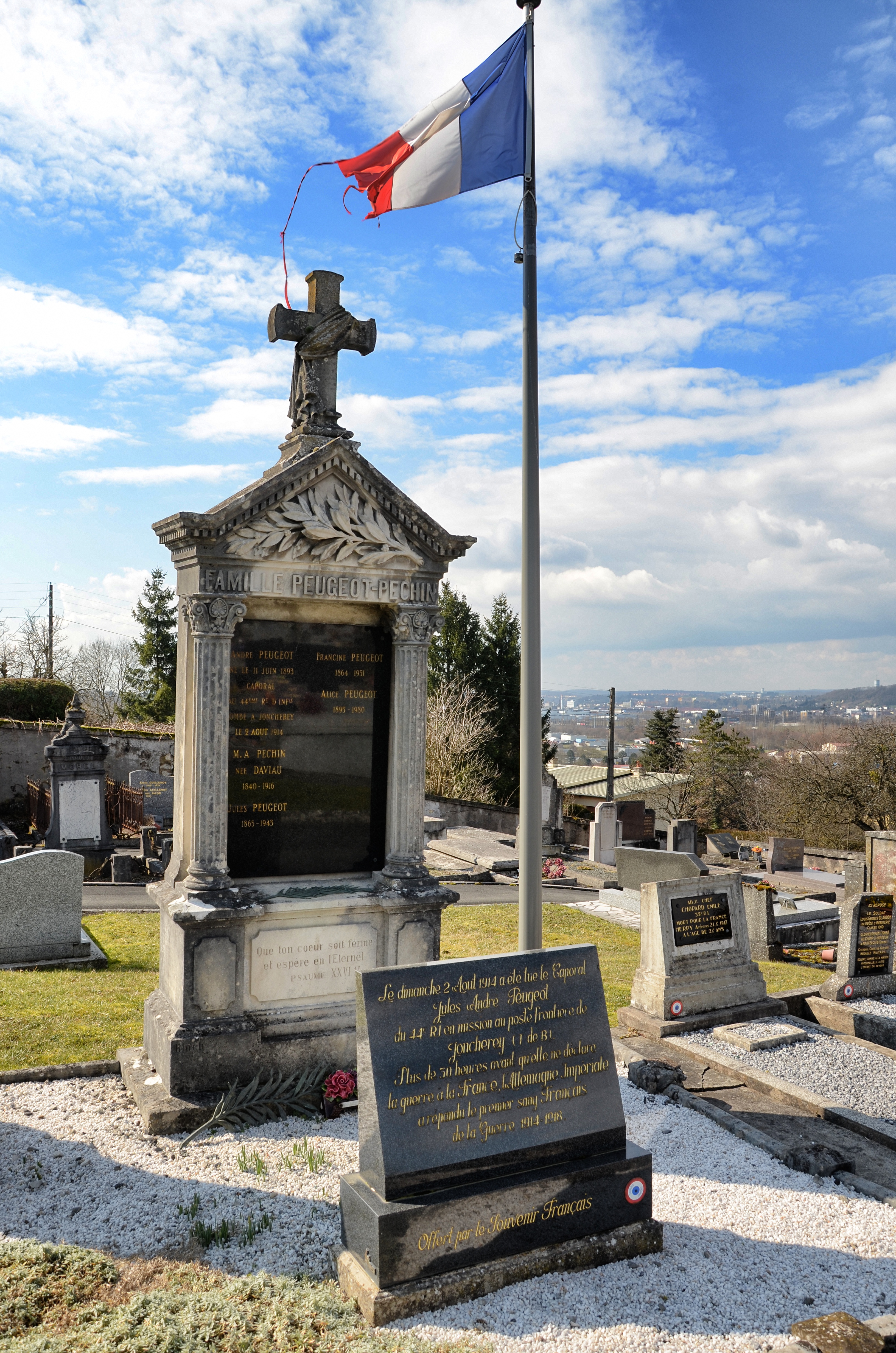
Peugeot is buried in the family grave (seen above) in Joncherey not far from where he was killed.

Peugeot’s Image on the memorial
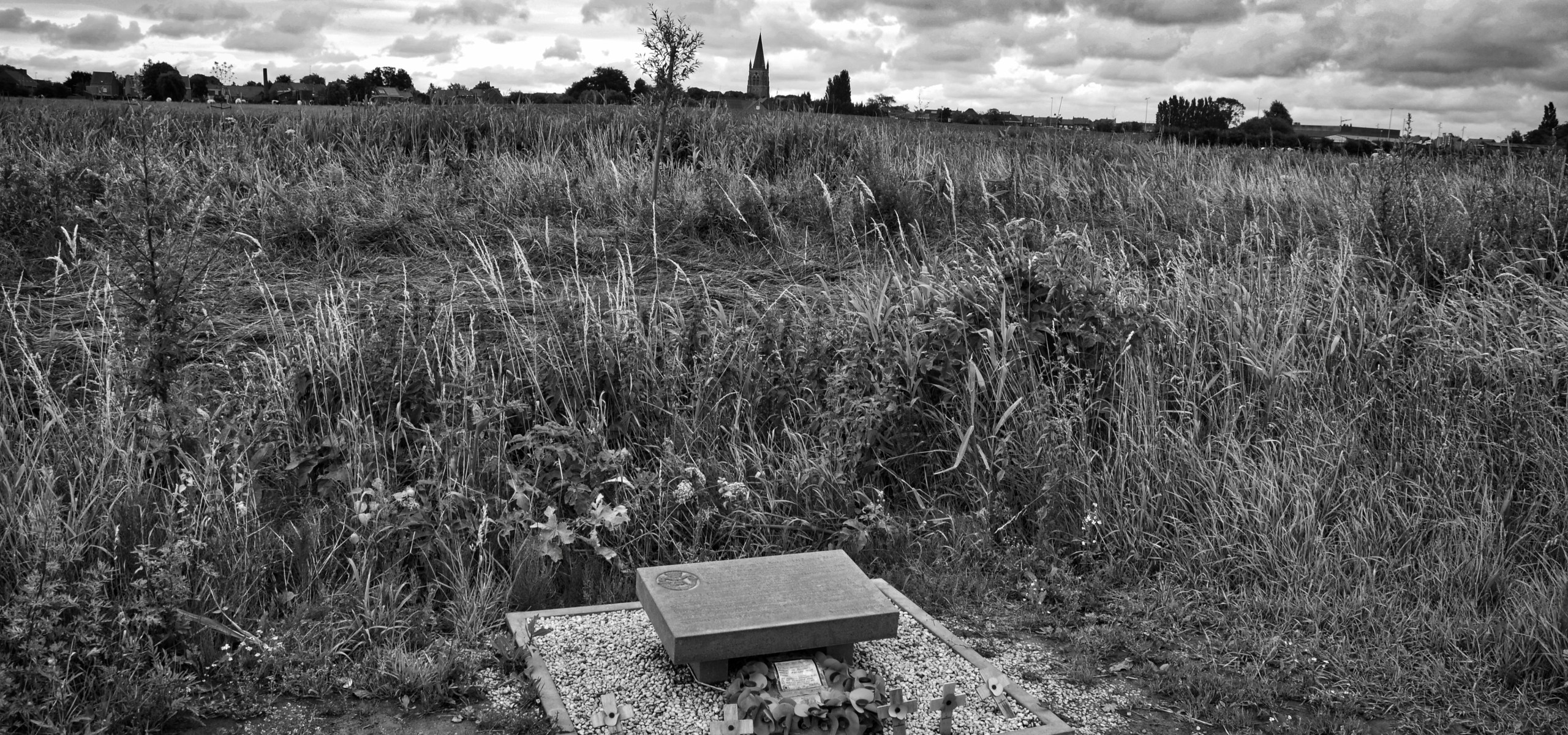
On this day in 2009 Great War veteran Harry Patch died aged an incredible 111 years. Often referred to as the ‘Last Fighting Tommy’, Harry Patch had served in Flanders with the Duke of Cornwall’s Light Infantry during the Third Battle of Ypres in 1917. He was the last surviving British soldier to have served in the trenches of the Western Front when he died and his face and voice have come to symbolise a whole generations of veterans who survived the war. His story has been an inspiration to many, and his story still brings many to Flanders to follow his war and remember all those who fought and died. Despite all this fame the memorial to Harry Patch is little known; tucked away just off the Pilkem-Langemark road close to the Steenbeek river; it is a simple stone recalling one of his visits to the area.
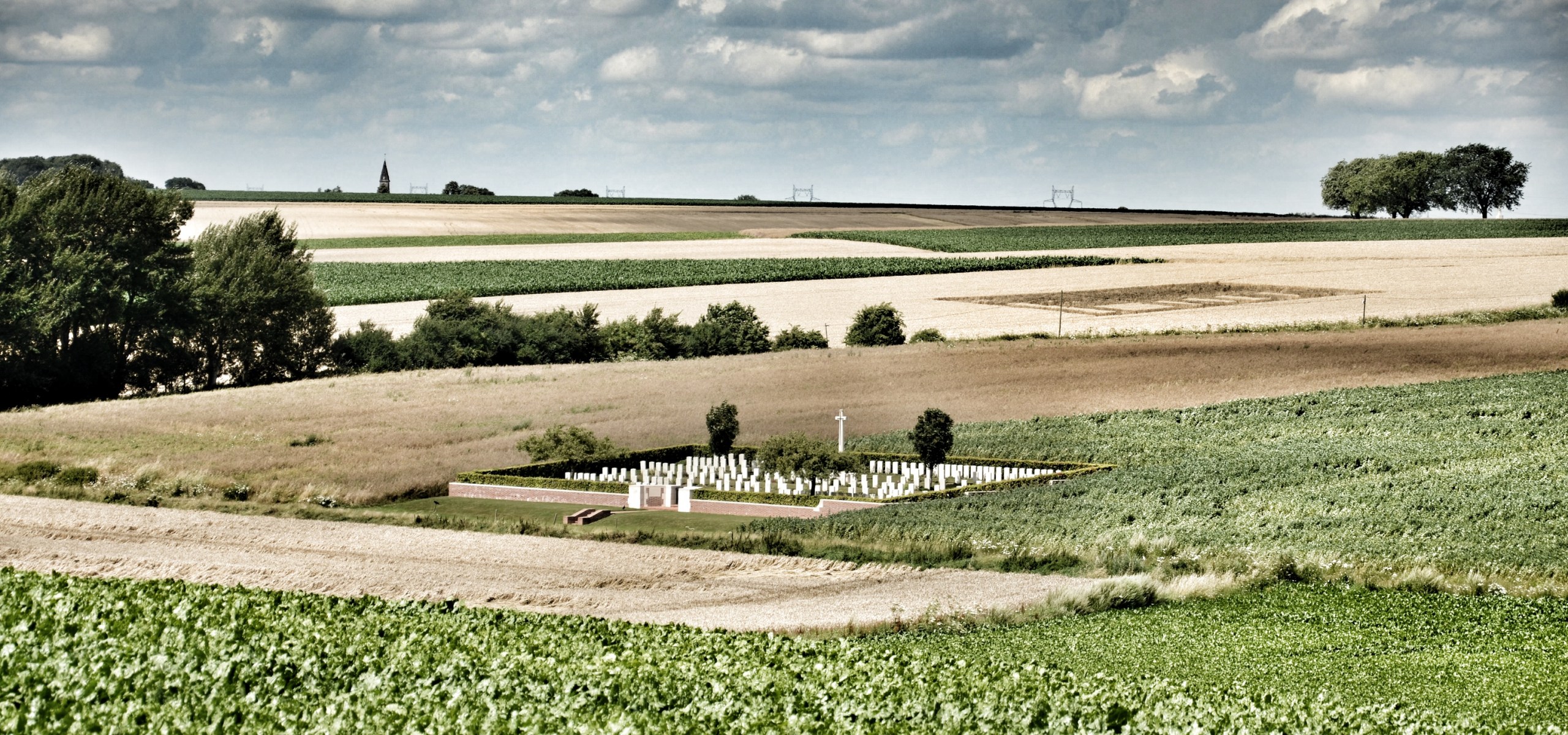
As the summer moves on, the rolling chalk downland fields of the Somme are filled with corn; blowing gently in the breeze as larks sing in the sky above. Here and there are scattered the small soldier’s cemeteries of the Somme battlefields; comrades cemeteries of men who fought and died together, now buried together. They mark the passage of conflict over this ground a century ago and their quiet majesty continues to inspire new generations of visitors to the battlefields of the Great War. This cemetery is Thistle Dump near High Wood, the scene of heavy fighting between July and September of 1916. There are 196 burials here, of which 59 are unidentified.

In the streets of Sarajevo on this day a hundred years ago the Serbian nationalist Gavrilo Princip stood up from beside a street cafe and emptied the contents of his automatic pistol into a car bearing Archduke Franz Ferdinand and his wife Sophie, killing them both. The outrage over the murder of the heir to the Austrian throne would bring about the conflict that became the Great War, and was the first of thirty seven days which lead to war in August 1914.
Princip was arrested in Sarajevo and eventually imprisoned in the old garrison town of Terezin. This would later become part of Czechoslovakia and during the Second World War the garrison became a concentration camp known as Theresienstadt. While today Terezin is best known for being a Holocaust site the cellblock where Princip was detained and died in 1918 has also been preserved and the Terezin museum includes a section on his imprisonment here.
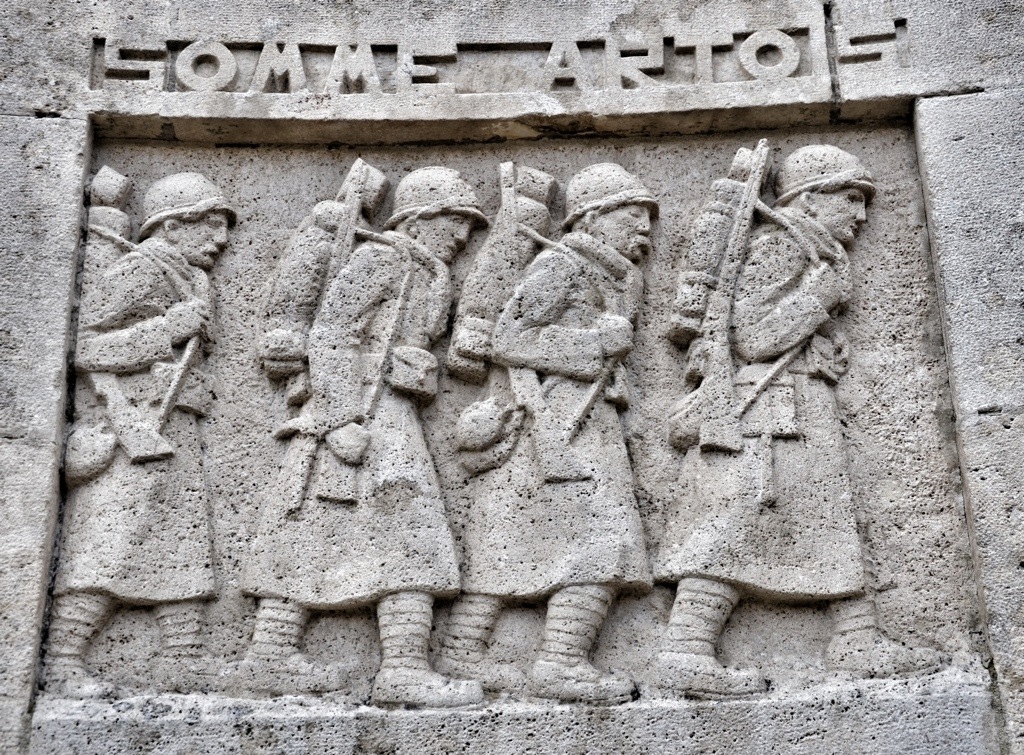
By the close of the Great War France had lost nearly 1.4 million dead and just as in Britain across the country every village, town and city was keen to erect a war memorial to those who had died for France.
The memorials vary greatly from lists in a frame on the wall of a church to impressive statues of French Poilu defying the enemy, or a fallen soldier draped in the arms of a woman who weeps for their loss. They are a study in their own right and as we come into the WW1 Centenary it seems France is become more and more aware of its war memorial heritage, which only can be welcomed.
This war memorial in Montmédy, a town north of the battlefield of Verdun and behind the German lines for most of the conflict. In 1914 it was close to the fighting in the Battle of the Frontiers and was finally liberated in November 1918. The war memorial features several friezes depicting Polius at war, including this one entitled ‘Somme Artois’.

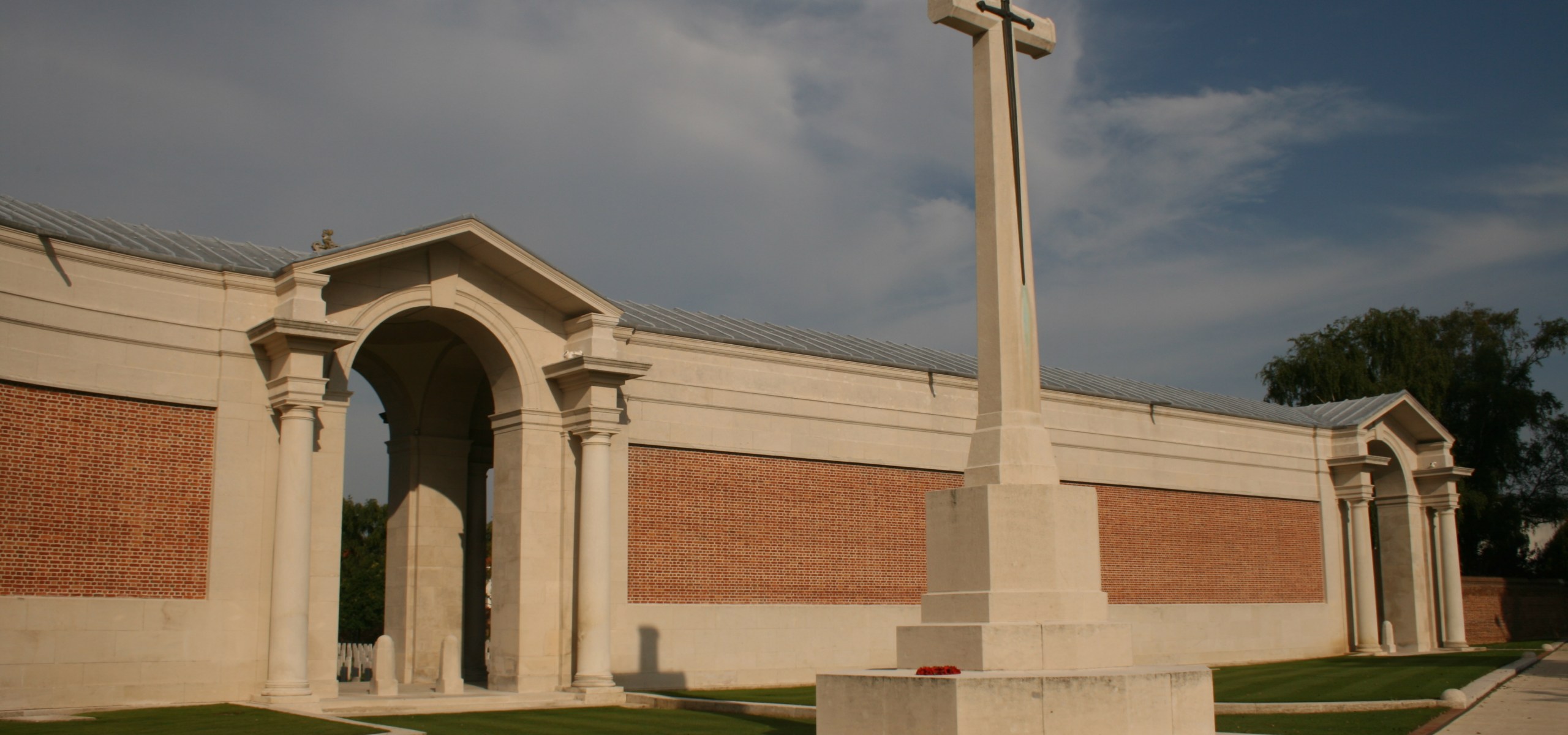
Today is the 97th Anniversary of the Battle of Arras, in some respects one of the forgotten battles of the Great War. Despite the huge amount of publications on Ypres and the Somme, in recent years only Jon Nicholl’s Cheerful Sacrifice, Peter Barton’s & Jeremy Banning’s Arras 1917 and my own Walking Arras have been published on this short but bloody battle. I blogged about this for the University of Oxford WW1 Centenary site last year but still remain disappointed that somehow Arras is neglected, even by battlefield visitors. Locally today the people of Arras will be commemorating the event as they do each year now and no doubt many will be thinking of relatives who fought and died there.
The Arras Memorial, seen here, commemorates 35,000 British and Commonwealth soldiers who died at Arras from 1916 until the end of the war, but a very high percentage of the total are men who fell in the fighting at Arras in April and May 1917.

” A ridge more densely sown with Australian sacrifice than any other place on earth!” C.E.W. Bean
The Pozières Ridge was the scene of heavy fighting between July and September 1916 when Australian, British and later Canadian troops pushed the Germans back over what was the highest point on the 1916 Somme battlefields.
On the nearby Pozières Windmill, which sites on the Ridge, an inscription reads:
“The ruin of Pozières windmill which lies here was the centre of the struggles in this part of the Somme battlefield in July and August 1916. It was captured on 4th August by Australian troops, who fell more thickly on this ridge than any other.”
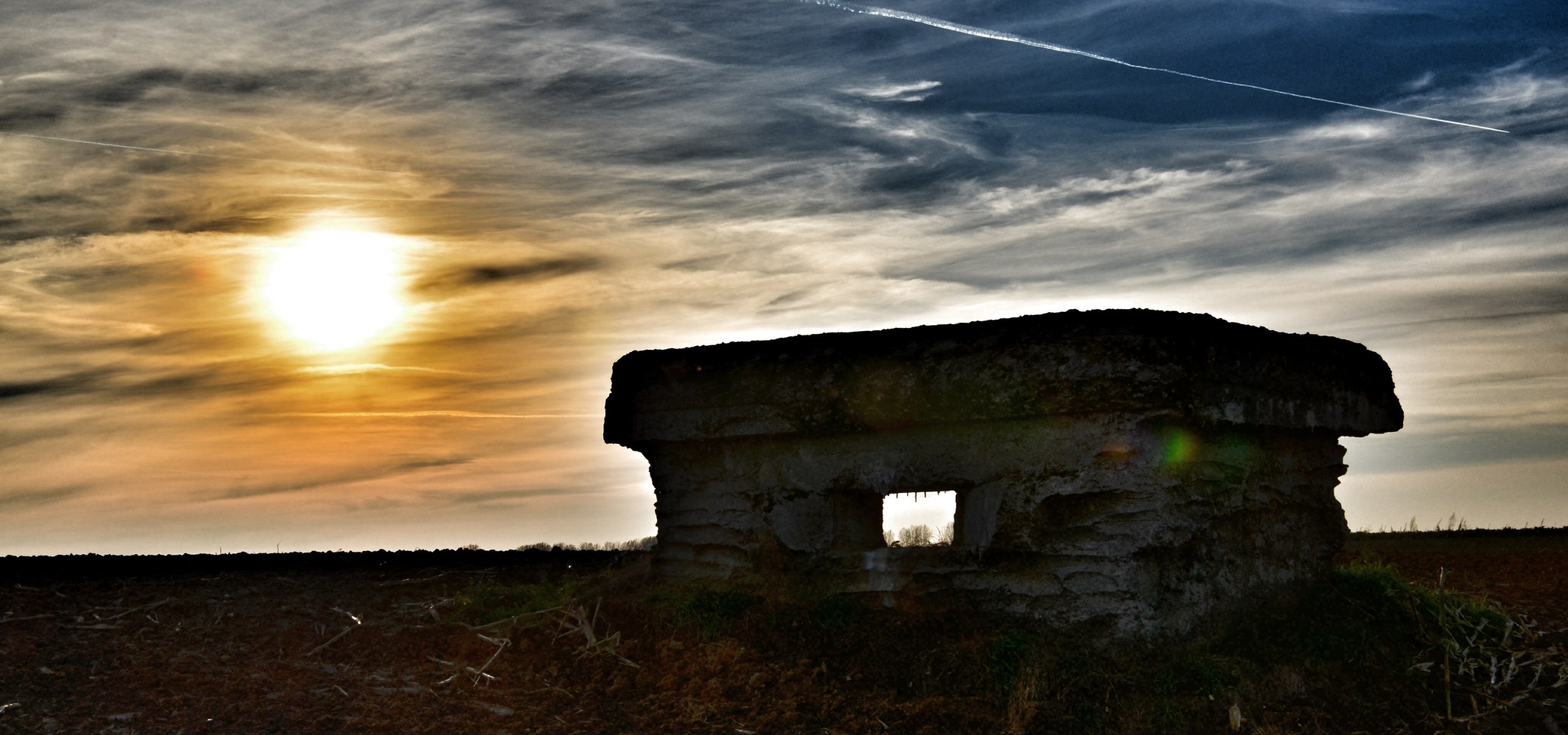
Standing like some of neolithic monument with the backdrop of an autumn sunset, this concrete British Observation Post bunker is one of two located on the road between the villages of Auchonvillers and Mesnil on the Somme. They were built before the Battle of the Somme to allow Staff Officers a clear view towards the front lines at Beaumont-Hamel and Thiepval and were in use when the battle started on 1st July 1916.

The landscape of Flanders around the city of Ypres was covered with the remains of trenches when the war ended in 1918 but as the civilian population returned and reclaimed their land, gradually they disappeared. Original trenches can only be seen in a few locations around Ypres now but for new generations coming to the battlefields it is often hard to equate muddy ditches or shallow holes with what was once here. At the Memorial Museum Passchendaele in the village of Zonnebeke a whole system of British and German trenches have been constructed to give a modern audience an insight into what the trenches looked like. Using experimental archaeology the museum has recreated different types of trenches and built using various styles and methods.
This mid-war British trench seems unusual at first in that it is straight and not zig-zagged; trenches were built like this largely to minimise the effect of shell-fire and also make them easier to defend. But there were straight trenches and they appear in contemporary images of the conflict. Along the floor a raised duckboard, or walkway, sits on top of an inverted A-frame to try and lift the occupants of the trench out of the water and the sides are lined with timber and ‘elephant iron‘ – corrugated iron sheeting, used to shore-up trenches and also often for roofing.

Les Crapouillots was a satirical magazine during the Great War and also the name given to the Trench Mortar branch of the French Army by the Poilus in the trenches.
This memorial in the village of Laffaux in the battlefields between Soissons and the Chemin des Dames commemorates 12,000 men of the unit who died on the Western Front. Constructed in the 1930s it was badly damaged in May 1940 during the Second World War, and later almost destroyed in a storm in 2008. The memorial has now been rebuilt and features in a new WW1 memorial park to commemorate the fighting in this sector.


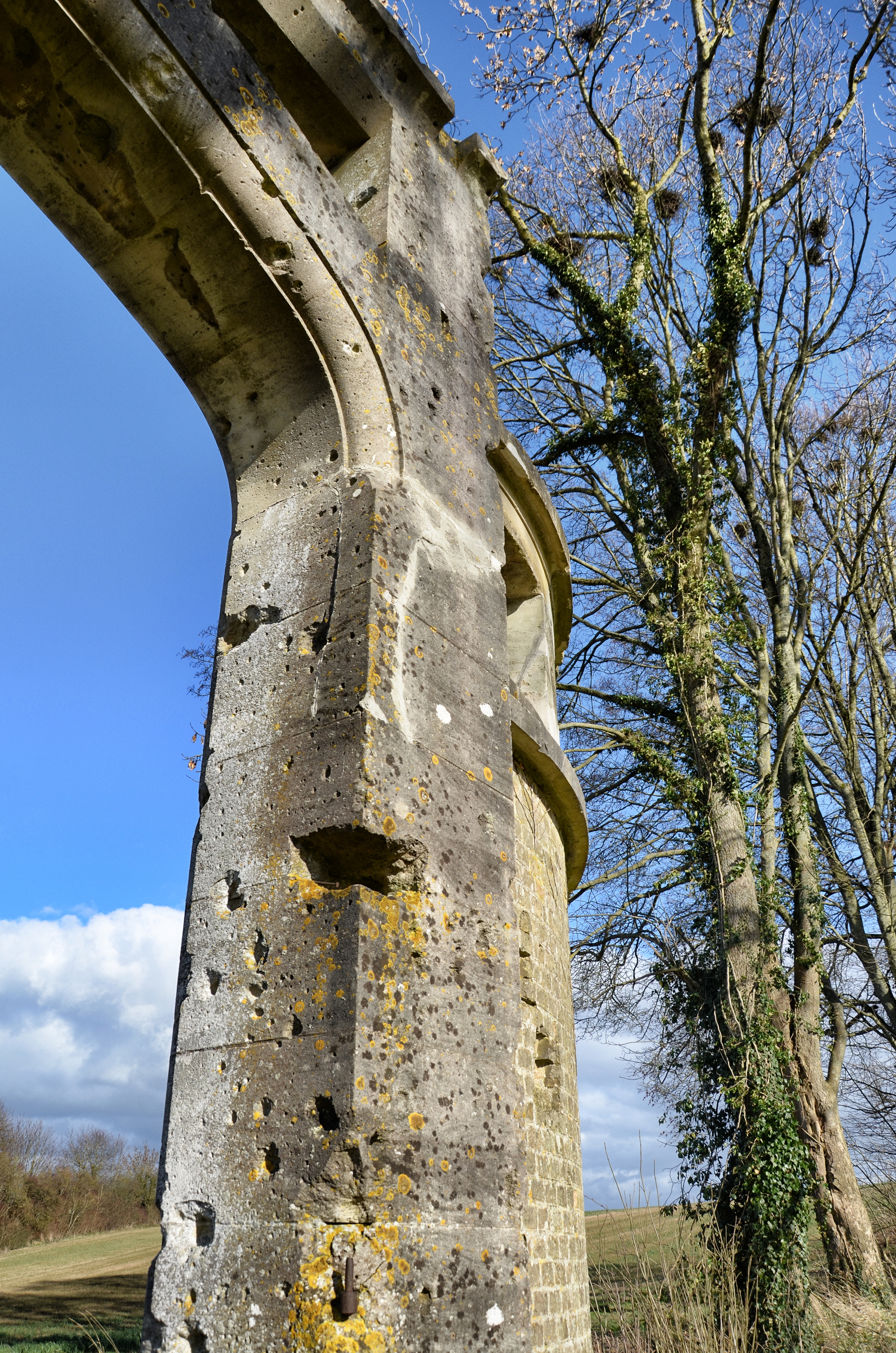
The village of Sommepy in the Champagne battlefields was behind the German front line for most of the war until the ruins of it were taken by American troops from the American Expeditionary Force in September 1918.
This archway, which was once part of the entrance to a large chateau, is the only remaining structure from the pre-1914 days still standing in the village. It is peppered with shell impact marks and also has graffiti from both WW1 and WW2 on it.
 WW1 Revisited
Comments on WW1 Revisited